Sizing
What Size Dumpster Do I Need? A Cape Cod, MA Guide
The 20 yard is one of our most requested sizes. How to choose between 10, 15, 20, 30 and 40 yards by volume, weight and driveway space on Cape Cod.
Guidelines · 8 min read
Most of what comes out of a house or a job site can go in a roll-off. The exceptions are the things Massachusetts bans from disposal or that need special handling, and each of them has somewhere else to go.
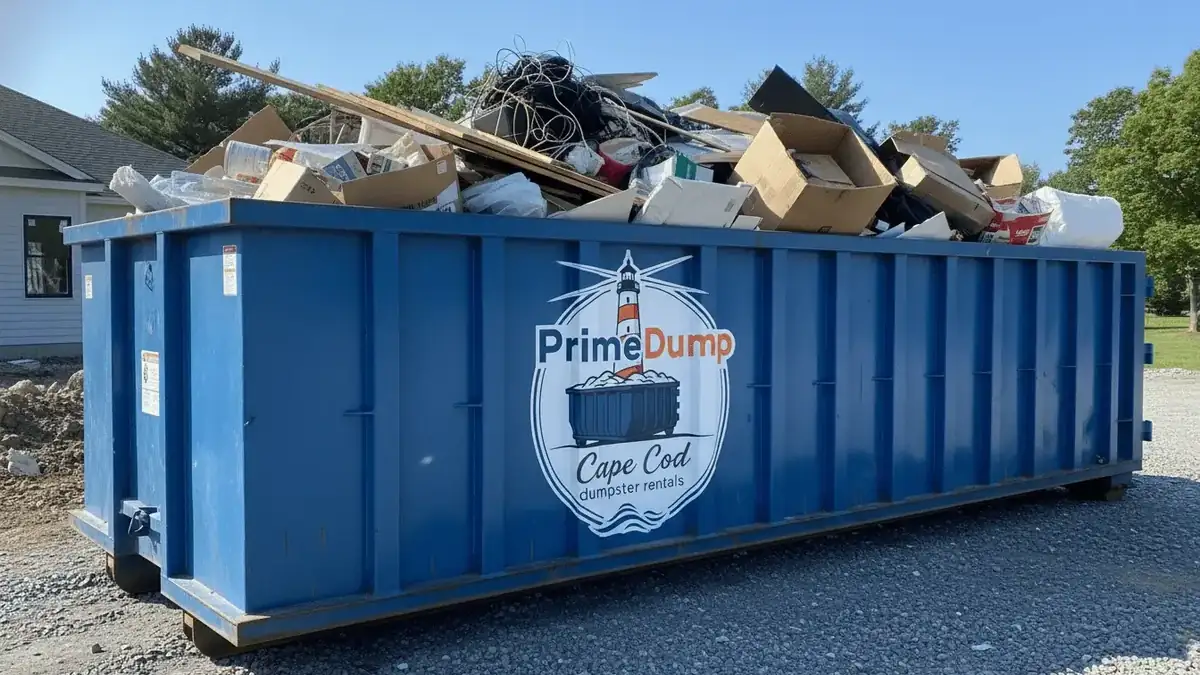
Several of those — concrete, brick, asphalt, metal, wood and clean drywall — are on the MassDEP ban list, but the ban is on disposal, not on the dumpster. Mixed construction debris goes to a handling facility that meets MassDEP's minimum performance standard, where the banned materials are separated for recycling, and a facility will not pass on mixed loads with clean drywall in them without first pulling the drywall out. A clean load of concrete or brick can go straight to recycling.
MassDEP's waste-ban rule says no person may dispose of, transfer for disposal, or contract to dispose of or transport a restricted material except as the rule allows (310 CMR 19.017(3)(a)), and that catches the hauler as well as the customer. Here is the list that matters for a roll-off, and where each item can go instead:
| Item | The rule | What to do instead |
|---|---|---|
| Mattresses and box springs, any size | Banned since November 1, 2022; one mattress is enough to fail a load | Our junk removal service; Falmouth residents can use the Town's Waste Management Facility ($50 per item, fee updated January 2026) |
| Textiles: clothing, footwear, bedding, towels, curtains, fabric | Banned since November 1, 2022 | Donate them; the Falmouth facility takes textiles from residents |
| White goods (large appliances) | Banned from disposal | Our junk removal service takes refrigerators, washers, dryers and stoves; the Falmouth facility takes white goods from residents |
| TVs and monitors with picture tubes (CRTs) | Banned; everyone must keep CRTs out of the waste stream (19.017(3)(c)) | Our junk removal service, which sends electronics through approved centers; the Falmouth facility takes e-waste from residents |
| Car and truck batteries (lead-acid) | Banned from disposal | The Falmouth facility takes batteries from residents; the county hazardous waste collections do not take vehicle or household batteries |
| Tires | Whole tires banned from landfills | Ask your town transfer station; the Falmouth facility takes tires from residents |
| Leaves and yard waste | Banned from disposal | A yard waste dumpster as its own load; Falmouth residents can use the Town's yard waste and leaf compost facility on Blacksmith Shop Road |
| Recyclable paper, cardboard, and glass, metal and plastic containers | Banned from disposal | Flatten cardboard and keep it together; bottles and cans go in your household recycling |
Three common myths. Asphalt shingles without asbestos are not banned; MassDEP encourages recycling them, but they can go in a roofing load. Furniture is not covered by the wood ban. And we found no new Massachusetts disposal ban in 2025 or 2026; the newest are still the mattress and textile bans of November 2022. Most town facilities serve their own residents only, so check your town's rules before you plan a drop-off.
Our own no list: paints, solvents and automotive fluids, batteries and electronics, propane tanks and fuel containers, tires, medical waste, asbestos, hazardous chemicals and refrigerators containing Freon. Some items are restricted for safety and environmental reasons, and the fire code adds two more: oily rags, and hot coals, cinders or ashes, which may not go in a combustible container (527 CMR 1.00, 19.3.1). For a yard waste box, keep out construction debris and household trash, so the load can be recycled. If you have questions about a specific material, call (508) 388-1861 before delivery and we confirm everything upfront; it is far cheaper than finding out at the facility.
Massachusetts makes the waste bans the hauler's business too: MassDEP inspects loads at disposal facilities to find haulers and generators who dispose of banned materials, and Falmouth's Board of Health tells permitted collectors to hand customers a copy of the MassDEP Waste Ban List and not to knowingly collect waste-ban materials (§§ 11.5, 11.6). So consider this our notice: banned items stay out of the box.
| Item | What to do with it |
|---|---|
| Oil-based paint, stains, solvents, pesticides and household chemicals | Barnstable County and the towns run household hazardous waste collection days from April through October, for residents; the rest of the year, MassDEP lists permanent facilities. Falmouth's Waste Management Facility does not take paints, stains or solvents at all. The County notes that latex paint is not hazardous waste. |
| Gasoline, brake fluid and other automotive fluids | The county household hazardous waste collections take them. Never in the box. |
| Lithium batteries and mercury devices | The county household hazardous waste collections take them. |
| Propane tanks and gas cylinders | On our no list, and the county collections do not take them either, so ask your town transfer station. |
| Fridges, freezers and A/C units | The refrigerant must be recovered first (40 CFR 82.155). Our junk removal service takes appliances, and recycles metals and appliances whenever possible. |
| Mattresses and box springs | Banned from disposal. Our junk removal service, or your town facility if it takes them. |
| Asbestos-containing materials | Never in our boxes, and the county collections do not take loose or friable asbestos. Survey, notice and disposal rules are below. |
| Medical waste | On our no list, and not taken at the county collections. Keep it out of the box. |
| Brush, branches, leaves and grass | A yard waste dumpster as its own load. Several town facilities refuse brush: Sandwich lists it as prohibited, Falmouth's facility does not take whole trees, stumps, branches or brush, and Wellfleet does not accept brush from landscapers, builders or commercial entities. |
Small businesses are different: the county collections accept waste from registered very small quantity generators, so call the Cape Cod Cooperative Extension before you plan around one. If you are outside Falmouth, check your own town's transfer station page for what it takes and from whom.
Federal law puts the duty on "The final processor—i.e., persons who take the final step in the disposal process (including but not limited to scrap recyclers and landfill operators)" of a small appliance, who must either recover any remaining refrigerant or verify, with a signed statement or contract naming who recovered it and when, that it has been recovered (40 CFR 82.155). On top of that, Massachusetts bans white goods, meaning large appliances, from disposal. So fridges, freezers, washers, dryers and window units stay out of our boxes. If you would rather not deal with them yourself, our junk removal service takes refrigerators, washers, dryers and stoves, and sorts items for recycling or proper disposal.
Before any demolition or renovation, the owner or operator must have an asbestos inspector thoroughly survey the building for suspect material (310 CMR 7.15(4)), and MassDEP says that applies to a structure of any age. Suspect materials include asphalt roofing and siding, roofing felts and tars, and cement or transite shingles. Asbestos removal needs a MassDEP notification ten working days before work starts, filed by the licensed abatement contractor. The separate demolition notice (AQ 06) is not needed for a residential building with fewer than 20 units, but the survey still is.
MassDEP says asbestos waste may not be sent to a combustion facility or to a construction and demolition processor, and asbestos-containing shingles must not be dropped or thrown to the ground. On the Cape, the Falmouth and Barnstable facilities refuse anything containing asbestos, Truro takes no asbestos of any kind, including shingles, and Eastham and Wellfleet list it as not accepted. Never put asbestos in a roll-off.
It pays to sort the way the waste bans do. A clean load of concrete, brick or asphalt can go straight to recycling; the same material mixed into a remodel load has to be pulled out at a handling facility. Remodel and tear-out debris is a different load again, and MassDEP's exemption for small loads of five cubic yards or less does not cover a roll-off. Yard waste is a third load: keep it separate from construction debris and household trash so it can go to a green-waste facility. Household junk from a cleanout is a fourth, and the one most likely to hide a mattress, a bag of clothes or an old TV.
Light household debris can usually be mixed, but talk to us before adding concrete, brick or roofing. Keep brush and leaves in their own load, flatten cardboard, and do not mix a household cleanout into a remodel box without telling us. If your project has both organic and non-organic debris, we can provide separate containers. If you are not sure where something belongs, call before you load it.
From this guide
No. MassDEP has banned mattresses and box springs from disposal since November 1, 2022, and one mattress is enough to fail a load. Our junk removal service removes mattresses, and Falmouth residents can take them to the Town facility for a per-item fee.
Yes. Asphalt shingles without asbestos are not a banned material in Massachusetts. They are heavy, so tell us the roof size and we help you size the box. Older roofing can contain asbestos, so the survey rules apply before a tear-off.
No. Picture-tube TVs and monitors and large appliances are on the Massachusetts waste-ban list, and fridges need the refrigerant recovered first. Our junk removal service takes appliances and electronics, and the Falmouth facility takes both from Falmouth residents.
None of them go in. Whole tires and car batteries are banned from disposal, and oil-based paint and chemicals go to a household hazardous waste collection, which Barnstable County and the towns run from April through October.
Keep reading
The rest of the series, same approach — official sources, no filler.
Sizing
The 20 yard is one of our most requested sizes. How to choose between 10, 15, 20, 30 and 40 yards by volume, weight and driveway space on Cape Cod.
Permits
The state fire-code permit, Board of Health hauler rules and the street rules in every Cape town from Bourne to Provincetown. Driveway first.
Cost
We quote every Cape Cod dumpster by phone. What a flat rate covers, what moves the price, and the transfer station limits and permits worth knowing.
Ready when you are
Call (508) 388-1861 with the address and what is going in. A quote and a delivery window before you hang up.
(508) 388-1861Open 24 hours, 7 days